 The new FX TV series Feud: Bette and Joan is a delightful and darkly funny look back at the notable and long lasting hostility between Hollywood Queens, Bette Davis and Joan Crawford. How accurate the show is and who was at fault is all beside the point. The show is wonderfully acted, bitchy, and overall entertaining. Susan Sarandon, as Davis, and Jessica Lange as Crawford lead the cast, but the supporting cast of Alfred Molina (director Robert Aldrich) , Judy Davis (Hedda Hopper), Stanley Tucci (Jack Warner), Catherine Zeta-Jones (Olivia de Havilland) and Kathy Bates (Joan Blondell) are all superbly played.
There is a strong irony in the casting of two older actresses, Sarandon (70) playing Davis then 54, and Lange (66) playing Crawford then 56. Joe Baltake of The Passionate Moviegoer, takes an interesting look at the sexism that existed, and yes still does, in Hollywood back then that proclaimed women in their fifties were too old and no longer relevant. Click on The Passionate Moviegoer to read.
I originally wrote about Whatever Happened to Baby Jane? back in 2010 on my Twenty Four Frames Blog. With the show in the middle of its run, I thought I would reprint the original here with just a few minor modifications.
 Whatever Happened to Baby Jane is a dark tragedy examining the underbelly of Hollywood in the tradition of films like Sunset Blvd or Day of the Locust wrapped up in a psychopathic thriller/horror film which it is generally lumped in with so often. Here are the outcasts, the losers, the has-beens and never was still clinging on to the hope that a chance of a comeback is in the making. It is also a story of sibling rivalry, jealousy, resentment and love all rolled up into a gothic nightmare that unravels into insanity and death.
The film brings together two icons of the Golden Age of Film, Bette Davis and Joan Crawford, the queens of MGM and Warner Brothers respectively, in their only big screen appearance together. Like the film itself, how the pairing of these two legends coming together is filled with drama, rivalry, and jealousy.
 How the two stars and the director came together is a demonstration of egos, vanity and maybe time playing tricks with the truth. Director Robert Aldrich claims he first had the idea of bringing these two stars together after reading the Henry Farrell novel while in Italy filming “Sodom and Gomorrah.” He soon after acquired the rights to the book. Crawford’s version goes that she told Aldrich she wanted to work with him again (They previously did Autumn Leaves) and also wanted to work with Bette Davis. She went to see Davis, who was appearing on Broadway in Tennessee Williams The Night of the Iguana, and after the show went backstage to offer congratulations, also telling Bette about the idea of the two of them working together. Davis, on the other hand, originally stated she read the novel a few years earlier and wanted Hitchcock to direct, but he was already committed to other projects. She later recanted this statement, finally claiming Joan’s version was closer to the truth. Then there is the version told by Bill Frye, producer of the TV show Thriller who states he discovered the novel while doing research for the show. Realizing it was too intricate for a half hour show he gave copies to Davis and Olivia DeHavilland with a mention that Ida Lupino would direct. The project was turned down by Universal head Lew Wasserman who did not want to work with Davis. Where and how the actual order of events happened is anyone’s guess, however, after looking at multiple biographies of the two actresses and interviews with Aldrich, it seems reasonable that the truth is buried somewhere between the Crawford and Aldrich versions (on the DVD it is said Aldrich initiated the project). The result was these two volatile stars whose professional and personal lives clashed agreed to make this film.
The story begins in 1917 and Baby Jane Hudson is a big vaudeville stage star, singing her crowd-pleasing song “I’ve Written a Letter to Daddy Whose Address is Heaven Above.” Offstage sweet Jane is an obnoxious spoiled brat who wants things her way because she is the one bringing in the money! When shortly after, Sister Blanche gets yelled at by their father, though she did nothing wrong, mother tells Blanche that someday she will be a big star and she wants her to be kinder to Baby Jane and father than they have been to her. Grimacing, Blanche swears she won’t forget!
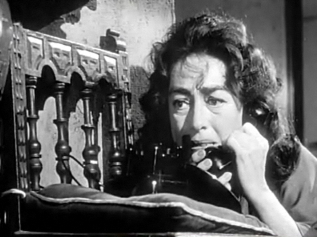 As the years go by Blanche becomes a major 1930’s movie star supporting Jane’s fading career by having a stipulation in her studio contract that for every film she makes Jane gets to make a film too. A mysterious car accident involving the two sisters leaves Blanche wheelchair bound.
It is now the present time (1962), and the two sisters live together in a gothic mansion on the outskirts of Hollywood with crazy Janie taking care of her invalid sister. When Blanche decides she wants a fuller life she elects to sell the house and plans to commit Jane to a home. Learning of her plans, Jane seeks revenge by terrorizing Blanche; cutting her off from the outside world. Jane also makes a feeble attempt to revive her own career by hiring obese out of work mama’s boy Edwin Flagg (Victor Buono), a composer, to help her musically with her comeback.
Bette Davis gives an appropriately over the top vicious performance as the mentality deteriorating Jane. Alcoholic, prone to fits of raging jealousy, dressing as if she were still ten years old, applying too much makeup, a deliriously hideous caricature of her former child star self. Davis would continue to apply more and more makeup to her face making herself more repulsive as the film progressed.
Davis who loved to give high energy performances takes full advantage of her role here. Crawford, on the other hand, gives a subtle low key controlled performance of a self-sacrificing woman, a role type she knew so well (Mildred Pierce), held helplessly hostage, in dire need of rescue from her out of control sister.
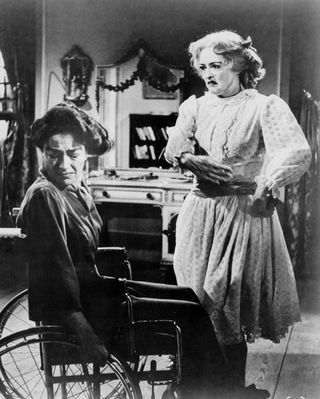 The casting of Davis and Crawford brought their real life conflict to the screen. Sure other older actresses could have played the two roles, but none would have supplied the natural tension that existed between these two women; Davis the high wired actress and Crawford the ultimate movie star. Nor would they deliver the personas that these two legends cultivated over the years. On the set, each in their own way antagonized and criticized one another. They were malicious and derogatory toward each other; both looking to collect allies and find devious ways to anger the other.
On the set, Aldrich had to contend with Crawford the MOVIE STAR and Davis the ACTRESS. Davis would get into her part of a raging maniacal out of control bitch, while Crawford ever thinking of her image would attempt to slow the pace down. In 1988, author Shaun Considine interviewed Baby Jane screenwriter Lukas Heller who said, “Crawford never reacted to anything, she sat in her wheelchair or bed waiting for her close-ups. As the camera got closer, she would widen those enormous eyes of hers. She considered that acting.” It was not all vanity for Crawford, she actually lost weight during the production to give herself a more gaunt look, though various sources have recorded how her breasts size actually changed all the time including the beach scene where she dies at the end.
Still, Aldrich states in an interview with Charles Higham in The Celluloid Muse that both ladies were profession during the shoot. He says, “The two stars didn’t fight at all on Baby Jane. I think it is proper to say that they really detested each other, but they behaved absolutely perfectly.” They may have, but according to various biographies, there were many snide remarks and some questionable actions by both. When Crawford wasn’t feeling well one day, she asked if they could take a break and Davis replied, “after all these years I thought we’d all be troupers.” Davis also accused Joan to others of spiking her Pepsi. As for Crawford, one story has it that in one of the final scenes Davis had to lift Crawford out of bed and carry her across the room. Davis had back problems and asked Joan not to make herself dead weight. After the one long scene, Davis screamed out in pain while Joan, looking a bit heavier nonchalantly walked off the set to her dressing room. It is said Crawford added weights under her costume. Crawford refutes this story. Both actresses knew that the publicity of a feud between them was, if nothing else, good for the film. Before working together, the two were probably professional rivals and not really personally feuding. By the end of the film, the two really hated each other.
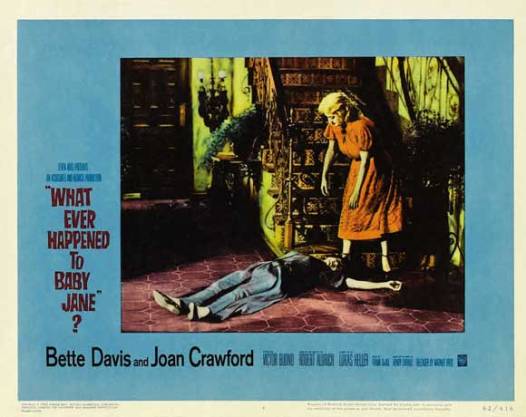 Davis was nominated for a Best Actress Oscar for the obvious, showy role of Jane while Crawford did not get a nod for her more restrained but equally effective role as Blanche. Far be it from me to make excuses for the Academy, but the Best Actress category for 1962 was a jammed pack group filled with superb performances. Along with Davis, there were Lee Remick for The Day of Wine and Roses, Katherine Hepburn for Long Day’s Journey Into Night, Geraldine Page for Sweet Bird of Youth and Anne Bancroft for The Miracle Worker. Still, Crawford’s performance was extremely effective and deserved some recognition, and she was not about to let her lack of a nomination stop her from outshining Davis on the night of the ceremony.
Bette Davis was positive she was going to win, adding a third statue to the two she already had. Crawford meanwhile had called all the other nominees mentioning to them that she would be available, on the chance they could not attend the gala, to accept the Oscar on their behalf. As it turned out, Anne Bancroft was unable to attend. When it was time to announce the Best Actress award, Davis was about to receive not one but two shocks. Anne Bancroft was announced the winner and accepting the award for her would be Joan Crawford! Crawford slid by Davis mumbling excuse me and walked up to receive the award basking in the limelight and attention. In Witney Stine’s book I’d Love to Kiss You…Conversations with Bette Davis, Davis says, “She pushed me aside backstage, and the triumphant look she gave me as she pranced around out on the stage, I’ll never forget…” She then adds, “She carted that Oscar around for a long time on her Pepsi tour, before she finally gave it to Bancroft.” Charlotte Chandler in her Joan Crawford biography, Not The Girl Next Door plays down the Oscar event calling Joan’s arranging to receive Bancroft’s Oscar, “a constructive approach.”
Whatever Happened to Baby Jane is a surprisingly violent and gruesome film for two Golden Age stars to have appeared in back in those days. Many people were upset watching Davis as Jane serve Crawford a rat on a plate (from what I have read Crawford was not aware the rodent would be on the plate), and seeing her kick Crawford in the stomach while she lies helplessly on the floor. In another scene, she drags poor Joan across the floor, and then just before Bette plunges a hammer into Elvira (Maidie Norman) the maid’s head, we find Joan gagged, and her hands bound hanging in bed. This wasn’t some teenage slasher flick starring unknown kids; this was Davis and Crawford, Hollywood royalty.
There are two notable supporting characters in the film, Edwin Flagg, played wonderfully by Victor Buono, in his film debut. Aldrich saw Buono in an episode of the TV series The Untouchables which impressed him greatly and signed him on. Buono received an Oscar nomination for his role. As Elvira the maid, Maidie Norman is a sympathetic soul who would not put up with Jane’s crap and became a victim of a violent death for her concern.
The film was the biggest financial shocker to come out since Psycho, just two years earlier, quickly earning back it approximate $1M budget. Speaking of the Hitchcock masterpiece, coincidently enough, the Hudson sisters’ next door neighbor is named Mrs. Bates. This Mrs. Bates though did not have a son named Norman, she had a daughter who was played by B.D. Merrill, Bette Davis’ real life daughter who would years later write her own tell-all book about mom. While the film is a classy thriller, Aldrich missed some opportunities to make this film more intense than it already is. For example, when Jane leaves the house and Blanche makes her way down stairs to reach a working telephone, the cross editing lacks any build up failing to register as much tension as a more effective editing style would have accomplished. On the other hand, there is some nice editing work in the sequence where Jane is kicking and stomping on poor Blanche. You can feel the pain of the swift kicks though you never really see any of the kicks make contact. Like the shower sequence in “Psycho” where you never see the knife enter the body but swear you do.
Davis went on a personal appearance tour when the film opened nationally in November. Apparently, Crawford was supposed to have joined in but backed out just before the tour was scheduled to begin. At one theater a fan yelled out, “where’s your sister?” Davis responded, ‘She’s dead on the beach” getting a big laugh.
Davis, Crawford, and Aldrich reteamed again for Hush, Hush Sweet Charlotte however, deep filtered conflict, hatred, jealousy and illness pushed the production into turmoil. After weeks of production, Crawford was out and replaced by Olivia De Havilland. Whatever Happened to Baby Jane was the beginning of a subgenre in horror films starring older actresses of the Golden Age, reviving their careers, at least temporarily, by appearing in these thrillers. In addition to Bette Davis (The Nanny, The Anniversary, Dead Ringer, Burnt Offerings) and Joan Crawford (Strait-Jacket, I Saw What You Did, Berserk, Trog) there was Olivia DeHavilland again in Lady in a Cage, Barbara Stanwyck in The Night Walker and a late entry, What’s The Matter With Helen? starring Debbie Reynolds and Shelley Winters.
References:
Bette and Joan – Shaun Considine
The Celluloid Muse – Charles Higham
Joan Crawford: Hollywood Martyr – David Brett
This ‘n’ That – Bette Davis
More Than A Woman – James Spada
Dark Victory – Ed Sikov
Conversations With Bette Davis – Witney Stine
Not The Girl Next Door – Charlotte Chandler


 Photography was in its infancy when Abraham Lincoln was running for President. It was a cumbersome and deliberate process. Cameras were these large boxes, set upon sturdy bulky tripods, using wet plates and a slow exposure making the possibilities of the sort of images captured limited.
 Dance marathons were phenomena that began in the 1920’s.
 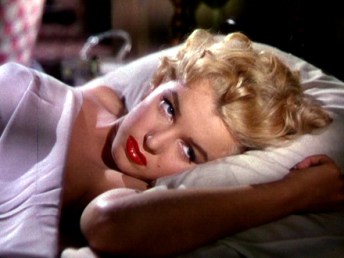 Marilyn Monroe stars in the 1953 Henry Hathaway directed film Niagara. It will be on TCM Tuesday August 1st at 10 PM Eastern time.
 One of my favorite crime writers is the late Donald E. Westlake. Westlake was awarded the title of Grand Master by The Mystery Writers of America, as well as a three-time Edgar winner. He wrote over 100 novels and numerous short stories and screenplays.

 Back in 1977, the author published a book called Enough. It consisted of two novellas, the longer of the two was called A Travesty, and the second, shorter story, was Orb. Enough may be one of the toughest of Westlake’s works to find a copy. I was fortunate enough a few years back to discover a copy at a local library. A Travesty is a dark, comic tale involving a sexually insatiable film critic, Carey Thorpe, who during a heated argument with one of his lovers accidentally kills her. Having seen too many movies, instead of calling the police, Thorpe decides to cover up his involvement in the transgression. Unfortunately, Thorpe’s lover was under surveillance by a blackmailing private investigator. Additionally, the investigating police detective takes a liking to our “‘hero,” and admires his amateur detective instincts. He’s also a frustrated screenwriter and would like Corey to take a look at what he wrote. Along the way, Carey is “forced” to commit a couple of more murders. Regrettably, for the film critic, his voracious appetite for sex does him in when he spurns the wrong woman.
 Let’s fast forward more than 30 years to 1999 and the premiere on TNT of a film called A Slight Case of Murder. It’s not to be confused with the 1938 Edward G Robinson film with the same title, but a made for TV film starring William H. Macy, Felicity Huffman, James Cromwell, and Adam Atkin. The film is based on A Travesty and adapted for the screen by Macy and director Steven Schachter. The duo faithfully captures the humorous essence of Westlake’s novella. The film critic’s name was changed in the movie from Corey to Terry, but much of the tale stays close to Westlake’s original work. It’s smart with plenty of visual and verbal nods to the noir films it’s sending up including Terry talking at times directly to the camera (in place of a voice-over). It’s filled with murders, sleazy characters and plenty of twists wrapped up in a funny script that film lovers, like myself, will especially love.

 I have been a big admirer of Robert B. Parker’s sparse style for many years. Since his death Ace Atkins has primarily taken over writing his Spenser series, and doing it with the same sharp dialogue and flavor as the master. Little White Lies is the latest.
 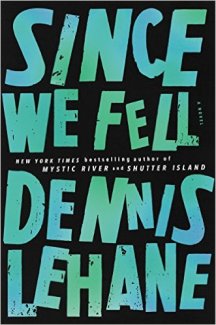 Just published, Dennis Lehane’s latest has been getting rave reviews. I have to admit, I have not read any of Lehane’s earlier books, however from what I have read, Since We Fell, is a bit different from his previous endeavors. That’s fine with me, since I am coming to him with fresh eyes.
 Shirley Jackson: A Rather Haunted Life by Ruth Franklin came out in September of last year. It’s been on my read list since I read the many positive reviews. The book made both the New York Times and Washington Post notable picks for 2016.
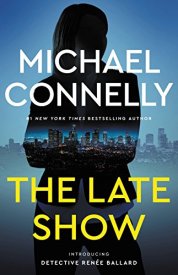
 In June,
 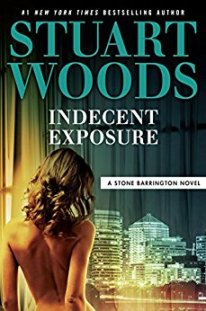 Stuart Woods’ Stone Barrington is a guilty pleasure. Barrington is one of those characters who has it all: looks, money, beautiful women and influential friends. He also manages to get himself in plenty of trouble, but not before buying another house, he has at least five, and bedding just about every woman he meets. The books have varied in quality lately, but are light fun reads.

 Last but not least on the film front is Dan Van Neste’s new biography of Ricardo Cortez which is a must read.
 Hemingway’s Cats – This book came out in 2015, but it only recently came to my attention while I was doing some research about authors and cats for a future post I am looking to write. The macho Hemingway love animals and had a special affection for cats. Throughout his life, from childhood to his suicidal end, the author had cats in his life. Author Carlene Brennan chronicles the felines in Hemingway’s life in words and photos.

 Burt Lancaster stars in the brutally powerful prison drama, Brute Force, showing on TCM tonight at 10:15PM (Eastern time). The Jules Dassin directed film is a strong indictment of the prison system for its corruptness and failures to rehabilitate.

 Hopper’s New York Movie
 Hopper’s expressionistic like Night Shadows
 Hopper’s Night Windows
 Hitchcock’s Rear Window
 Hopper’s Nighthawks
 Robert Siodmak’s The Killers
 John Greco Author/Photographer