
 At 5’ 5” Joe Rosenthal had to place some rocks and sandbags on the ground for him to stand on so he could take what would become one of the most iconic photographs of World War II: the raising of the American flag on the small Japanese island of Iwo Jima. Located 760 miles south of Tokyo, the island was crucial to American forces strategies who planned to use the volcanic island as an air base in their march toward Japan.
 Joe Rosenthal
Rosenthal, who died in 2006 at the age of 94, was born on October 9th, 1911 in Washington D.C. to Russian Jewish immigrants. During the Great Depression, Joe moved to San Francisco where he lived with his brother as he searched for work. It was during this period, Joe developed an interest in photography; what began as a hobby, soon turned into a career when he got a job working for the Newspaper Enterprise Association.
Nearsighted, Rosenthal was classified as 4-F around the time of the surprise attack on Pearl Harbor. However, through connections, he managed to get his 4-F status overturned, and would spend his first year of military service in Europe and North Africa. In 1944, he convinced the Associated Press to give him credentials as a war photographer. Rosenthal was sent off to the Pacific where he was present for the invasions of Guam, Anguar, and Hollandia.
On Feb 19, 1945, Rosenthal landed on the Japanese fortified island of Iwo Jima with the first wave of U.S. Marines to come ashore. Dodging bullets, Rosenthal’s only weapon was his unwieldy Speed Graphic, shooting shot after shot of dramatic battlefield photos during those first days of the invasion. About four days into the battle, and after suffering heavy losses, the Marines made their move up Mount Suribachi; the tallest point on the island, and the Japanese stronghold. After a fierce struggle, the Marines controlled the mountain. Louis Lowery, a photographer for the Marine publication Leatherneck, arrived on top of the mountain first and photographed the raising of a small American flag. It was the first American flag to fly on Japanese territory.

The raising of the first U.S. flag – Photography by Louis Lowery
Rosenthal did not make it up to the top in time for that first flag raising, but he along with two other photographers still chose to make the trek up the hill. Meanwhile, the Marine command decided to replace the original small flag with a larger flag. Rosenthal, arrived with his Speed Graphic in hand, as the soldiers were preparing to raise the second and bigger flag. He quickly got himself into position, on top of those rocks and sandbag, and shot a series of photos including the shot that would be seen around the world.
At first, it was one of many photographs Rosenthal took that day; he thought nothing was special about it, it was just one of the numerous images he captured on film. He noted the shutter speed at 1/400 with an aperture of F/11. The film was sent to Guam and the Associated Press headquarters where it was processed and transmitted back to the States.
Then it happened. The picture began to appear in just about every Sunday newspaper across the country. The photo became a sensation, and a symbol back home that the war was starting to turn. Rosenthal was awarded the Pulitzer Prize. The committee described it as depicting “one of the war’s great moments.” Five months after the flag raising, a stamp with Rosenthal’s photo was issued. It was the first time a living person appeared on a U.S. stamp. Time magazine includes it in its list of the 100 Most Influential Images of All Time. Today, Joe Rosenthal’s picture remains one of the most iconic and recognizable photographs of war ever taken.

In Clint Eastwood’s 2006 film, Flags of Our Fathers, based on a book by James Bradley and Ron Powers, we first meet Joe Rosenthal (Ned Eisenberg) as an older man. He is being interviewed by James Bradley (Tom McCarthy), the now adult son of John “Doc” Bradley (Ryan Philippe), a Navy Hospital Corpsman assigned to the U.S. Marine Rifle Company invading Iwo Jima. James is researching his father’s life for what would become the book, Flags of Our Fathers. While a younger version of Rosenthal appears later on in the movie recreating the Flag raising on top of Mount Suribachi, it’s this early scene listening to the photographer talk about the historic photograph and its relevance that is most fascinating. Rosenthal states how he took many other photographs that day, many depicting the raw cruelties of war. No one wanted to see them. Somehow though, he goes on, “we had to make some sense of it; we needed to make it easy to understand, using few words. The right photograph can win or lose a war.”
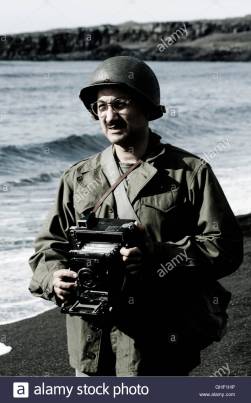
Ned Eisenberg as Joe Rosenthal in Flags of Our Fathers
“Look at Vietnam,” he continued, referring to Eddie Adams famous photo of the 1968 execution by South Vietnamese National Police Chief, General Nguyễn Ngọc Loan, holding a raised 38 caliber pistol, coldly shooting Viet Cong prisoner, Nguyễn Văn Lém, in the head, right on the streets of Saigon. “That was it!” he continues, “the war was lost. We just hung around trying to pretend it wasn’t.”
Rosenthal goes on to discuss how his picture helped turn the perception of the war back home. People back home saw the photo, and it changed their opinions; the war was beginning to go in America’s favor. Folks were buying bonds and feeling good.
In their own time, both Rosenthal and Adams pictures reverberated around the country, and the world, one photograph helped win a war; the other helped realize another war was a lost cause. Both men won a Pulitzer Prize for their work.
Photographs tell a hard truth, yet they can, and do lie. In both Rosenthal’s and Adams pictures, we see one side, what the photographer photographed. We never know what came before or after. We see just what they want you to see, a moment in time. What both these photographs do reveal, though taken more than twenty years apart, is the power of the visual image. No words are necessary. The picture tells the story.
Joe Rosenthal’s career spanned more than 50 years, however, like many photographers, there is that one image that he remains best known for and has become iconic.
 Sign up for my newsletter and be kept up to date on my books, articles, photography and other interesting happenings.




 Photography was in its infancy when Abraham Lincoln was running for President. It was a cumbersome and deliberate process. Cameras were these large boxes, set upon sturdy bulky tripods, using wet plates and a slow exposure making the possibilities of the sort of images captured limited.


 Andre is back once again at my laptop pounding on the keys. I can only hope he is not writing his memoirs. If he is, I am in deep trouble!
 Cats and writers have a special bond. Their connection runs deep. Maybe it’s a meditative thing, maybe it’s inspirational or spiritual. Whatever it is, for many authors cats are an essential part of their lives.



 John Greco Author/Photographer