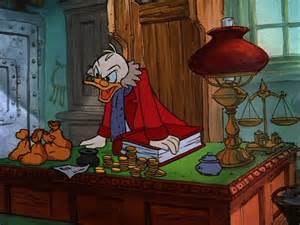
When asked to donate to help the poor for the holidays the greediest, grumpiest Grinch of all time, Ebenezer Scrooge, replies “Are there no prisons? Are there no union workhouses?”
One of the greatest characters in Charles Dicken’s brilliant library of creations is Ebenezer Scrooge. He’s the epitome of meanness, a tower of cold unmoving steel, dismissing Christmas with the wave of a hand and his own personal mantra, “Bah Humbug!” It’s a phrase that has become part of our everyday language.
It was Dicken’s ability as a writer to take a wretched old geezer, full of nastiness and miserliness, and convincingly have him find redemption.
This time of the year I always try to watch at least one film version of A Christmas Carol. This year, it was the 1938 film with Reginald Owen as Scrooge. I didn’t think Owen made for a great Ebenezer, but the film is entertaining and certainly worth watching.
With all that said, below is a list of my the top five A Christmas Carol movies.
5) Scrooge (1970) with Albert Finney if for no other reason that than for the show stopping, Thank You, Very Much number.
4) Scrooged (1988) with Bill Murray. Enough said!
3) Mickey’s Christmas Carol (1983) just because Scrooge McDuck rules!
2) A Christmas Carol (1984) George C. Scott’s gruff voice and demeanor are pure perfection.1) A Christmas Carol (1951) Nobody does it better than Alastair Sim. The film itself is a holiday masterpiece.
Today is Kirk Douglas’ 100th birthday. One of the last survivor’s of Hollywood’s classic era, Douglas gave us a series of roles ranging from the cynical (Ace in the Hole) to the heroic (Paths of Glory). Douglas, like his five time co-star, Burt Lancaster, were bigger than life on screen. They were stars, the type that no longer exist.
Below is a link to my new post over at my film blog (Twenty Four Frames), Gunfight at the OK Corral, that is part of Shadow and Statin’s Kirk Douglas 100th Birthday Blogathon.
I am a contributor to the new ebook, Hollywood on Hollywood: Ten Films About Tinseltown from the Classic Movie Blog Assn. (CMBA). Ten articles on classics like Sunset Blvd and What Price, Hollywood to more recent films like L.A. Confidential and The Player.
The book is available on both Amazon (.99 cents) and Smashwords (free PDF file). All proceeds from the Amazon sales are donated to Film Preservation. Links below.
It happened on September 30, 1976. Martin Ritt’s film, The Front, starring Woody Allen, opened that day at the Coronet theater in New York. I have been, and still am, a huge Woody Allen fan since his standup days when I first saw him on the Ed Sullivan Show.
At the time, I was living and working in New York. Being the Woody fan that I was, I took a half day off from work to go see The Front. The Coronet theater was located on Manhattan’s Eastside. The Coronet, its sister theater, the Baronet along with the Cinema I and Cinema II were high end theaters. All the studios and distributors wanted their big films to be booked into these theaters. Foreign films like Bergman’s Cries and Whispers and Antonioni’s Blow-Up to domestic works like The Exorcist and The Graduate had their premiere engagements at one of these fours theaters located on the Upper East Side. The four theaters filled the entire block, between 59th and 60th streets, except for a Bookmasters store in between.
The theater was fairly crowded for a weekday afternoon. In New York, Woody was always a big draw. After the film ended, everyone began filing out. It was at this time, I suddenly noticed walking out right in front of me among the crowd were John Lennon and Yoko Ono. Growing up in the 60’s, and a Beatles fan, I pretty much stood there stunned. In truth, while I saw the both of them, it was Yoko who I first recognized. I had to take a second look at who was standing next to her. Of course, it was Lennon.
They and everyone continued to slowly leave the theater. A few folks said hello and he returned the acknowledgement. Most people just looked and gawked, like I did. Some, I am sure didn’t even recognize them, though they are hard to miss. New Yorker’s can be a jaded bunch and seeing famous people in the street is not an uncommon experience. A few famous people though can even shake up the jaded New Yorker. Lennon was one of those.
I purposely stayed a few steps behind them all the way out of the theater until we all were out in the street. For those who are unaware, that block of theaters were located directly across the street from Bloomingdales. That was John and Yoko’s next destination. They crossed over 3rd avenue and disappeared in the department store. I stood by the theater watching them, cursing to myself that I did not have my camera with me. This naturally was in the days long before cellphones.
I never saw The Beatles in concert, but over the years I did get to see Paul, George and Ringo separately in concerts. Never did with John, however, I did get to go to the movies with him… sort of.
Grace Kelly, James Stewart and Alfred Hitchcock watch as L.A. Times press photographer Phil Bath goes over some of the photography equipment used in the 1954 classic, REAR WINDOW. Stewart portrayed a magazine photographer injured during a photo shoot. Laid up in his Greenwich Village apartment he spends his days watching his neighbors through his window. Then one day he witnesses a murder…or did he?
I wrote about this film twice on my film blog, Twenty Four Frames. The links are below.
This weekend TCM pays tribute to America’s fallen heroes with three days of mostly pro-war films like The Flying Leathernecks (1951) and They Were Expendable (1945) both featuring the always hard-ass but plastic patriot John Wayne. When the war broke out stars like Henry Fonda, Robert Stack, Clark Gable and James Stewart joined the military. Wayne on the other hand did not. Though eligible, he felt his career was more important. Wayne managed to obtain a 3-A status, “deferred for family dependency.” He had four kids. Additionally, El Duko’s career was not on solid ground at the time. He had just completed Stagecoach and was on the road to stardom. Four or five years of military service could have ruined that. Additionally, actor’s in general, were given a bit of leniency because the Gov’t considered Hollywood a propaganda machine for the war effort. Continue reading “John Wayne – Amercian Hero?”→
Famed Hollywood photographer George Hurrell began his artistic life as a painter. He began to use a camera to photograph his artwork. Hurrell soon found out that he could make more money as a photographer. During this period he was introduced to actor Ramon Navarro by pioneer aviator Florence Lowe “Pancho” Barnes (Hell’s Angels) and took a series of photographs of the actor. Navarro was happy with the results and showed them to Norma Shearer who then requested Hurrell take a series of provocative photographs of her. Pleased with the results by both Shearer and her husband and MGM production guru, Irving Thalberg, he was hired by MGM to photograph their galaxy of stars. In later years, Hurrell would eventually move to Warner Brothers. Combined, Hurrell would have the opportunity to photograph some of the biggest of Hollywood stars including Clark Gable, Jean Harlow, Jane Russell, Bette Davis, Ann Sheridan, James Cagney, Humphrey Bogart and Joan Crawford. Continue reading “George Hurrell and Mommie Dearest”→
Robert Ryan is TCM’s Star of the Month. On Friday, May 6th beginning at 11am (ET) TCM will be showing 13 films of Ryan’s darkest works including The Racket, Act of Violence, On Dangerous Ground, The Set-Up and Beware, My Lovely.
James Garner would have been 88 years old today. The actor whose career began in the early 1950’s hit it big with his 1957 TV western, Maverick. From there he went on to movies like The Great Escape, The Children’s Hour The Thrill of it All, Boy’s Night Out, Move Over, Darling and The Americanization of Emily in which he co-starred for the first time with Julie Andrews.
James Garner and Julie Andrews made a great team. Garner confesses in his blunt memoir (The Garner Files), the lovely Ms. Andrews was a great kisser and he really enjoyed doing their love scenes. They would reunite on-screen some eighteen years later in her husband’s (Blake Edwards) Victor, Victoria.
Garner’s career would shift back between movies and television over the years. What always remained the same though was his likability and his talent in both drama and comedy.
You can read more about Garner and The Americanization of Emily in my new e-book, Lesson in the Dark. Available on Amazon for only $2.99.
Back in the 1970’s, after my discharge from the Army, I enrolled in a class at the New York Institute of Photography. I got interested in photography after I purchased my first 35mm camera while stationed in Vietnam and later learned some darkroom development techniques while stationed in Germany. I bring this up only because the instructor during one session asked the class who they thought was a better photographer, Richard Avedon or Gordon Parks. Why he selected these two I don’t remember. Anyway, I made it known that I thought Parks was the better photographer. The instructor who I later classified as a typical know it all who liked to belittle people told me how I was wrong and that Avedon was the better of the two. The class laughed as he seemed to go on about my choice and belittling me in the process. I shrunk into a quiet embarrassed mode. I hated the class for the rest of the few weeks that I silently attended before dropping out.
I was naïve about photographers at the time and could not mount any sort of defense for my position. Today, I would say that the comparison was ridiculous to even make. The two men are masters. However, their work comes from two different directions and styles. As I learned more about my own style and taste in photography I can look back and see why I selected Parks. I’m not big on studio work. I prefer being outside and capturing those “decisive moments” in life as Henri Cartier-Bresson calls them, though my “moments” are more in nature than the streets of Paris .
I first became aware of Gordon Parks while in the Army. It was in the late 1960’s and his first feature film, The Learning Tree, played at the theater located on the base. It’s a charming and poignant semi-autobiographical film about a young black teenager growing up in rural Kansas. The film was based on Parks own novel. It’s certainly worth watching if and when the opportunity arises.
As I became more and more interested in photography I became familiar with Parks photographic work. As the first black staff photographer for Life magazine, his work was street wise, powerful and emotionally moving. I would later learn Gordon Parks was not just a photographer and writer but a true modern day renaissance man: Photographer, author, poet, filmmaker, and composer. He did it all and he did it all well.
Parks second feature film was his big break out film as a director. Shaft was a blaxploitation that commercially broke through the color barrier. With Richard Roundtree in the title role, Shaft was a super cool P.I. A modern day Bogart. Isaac Hayes in his hit title song says it all.
Who is the man that would risk his neck
For his brother man?
Shaft, can you dig it?
Who’s the cat that won’t cop out
When there’s danger all about?
Shaft, right on
Parks made two other films in the coming years, Shaft’s Big Score and The Super Cops. Then in 1976 came Leadbelly… Huddie Ledbetter, aka Leadbelly, aka Lead Belly was one of America’s great folk/blues singers. His influence on artists such as Woody Guthrie, Pete Seeger, Creedence Clearwater Revival, Bob Dylan, Johnny Rivers, Tom Waits, Ry Cooder, Elvis Presley and so many others has been well documented in their recordings. Huddie was inducted into the Rock and Rock Hall of Fame back in 1988.
Park’s film paints an evocative portrait filled with images of a segregated South that kept many down and out folks filled with hardship and suffering as well as hope and dreams. Still, their lives were filled with music – the Blues. As portrayed by Roger Mosely, Huddie was a restless soul filled with hope and dreams. He wanted to hit the road, and as a young man he did, performing in whorehouses and other venues. Anywhere they would let him sing. However, his road was filled with a series of rough ‘bumps’ along the way including long stretches in prison. What never stopped was his love of music playing gospel, folk and those blues.
From what I have read, Park’s evocative film come across as a fairly accurate portrait of the musician’s rocky road in life. In real life Huddie killed at least two men and spent a lot of time in Texas prisons working on the chain gang. In the film we see two separate incidents where Huddie ends up killing another man. One is unintentional, the second was in self-defense. As Roger Ebert writes in his original review, “His crimes are matched by the crime of the chain-gang system, designed to break his spirit. It fails.”
One of the finest parts of the film comes early on when Huddie meets Blind Lemon Jefferson. Lemon, another soon to be blues legend, is superbly played by Art Evans (Die Hard 2, A Soldier’s Story and many, many TV shows). The two bluesmen team up for a while performing on the road (in real life it was about two years). In one scene during this period they sing for white people at a dance party. It turns ugly when the evening begins to get late and Huddie decides to pack it in. However, one of the white folks wants him to continue and a fight ensues with Huddie getting badly beaten. It always seems even when Huddie wasn’t looking for trouble, it found him.
Years go by. The chain gang, by design, breaks men’s souls. However, Huddie’s self-respect and spirit remains in tack. He eventually get out of prison. Legend and the film claim that after performing, playing his 12 string guitar and singing, for the Governor who is so taken by Huddie’s simple “darkie” performance that he tells the prisoner when his term is up as Governor, one of the last things he will do is give Huddie a pardon. Of course, this sounds like bull, but surprising enough, though some time has passed, the Governor kept his word and the blues singer gets out of prison. In real life Huddie was released early due to his good behavior. Also with the Great Depression came a series of budget cuts and Huddie’s good record helped him out as well with the selection of prisoner’s to be released in order to cut expenses.
The film is told in flashback. During his last stretch on the chain gang Huddie is visited by musicologist John Lomax who has been recording and archiving rural folksinger’s for the Library of Congress. By now, Huddie is older and gray haired. As the recordings begin he looks back on his life. In real life Lomax visited and recorded Ledbetter on two separate occasions. First in 1933 and again one year later in 1934. It was a month or so after this second visit that Huddie was pardoned.
LEADBELLY, I.V.
Fact or fiction, Leadbelly is a good film that is rarely seen, though it does show up sometimes in February during Black History Month. The folksinger is best known for songs like Goodnight, Irene, The Midnight Special, Rock Island Line along with many others. After his prison time he performed around the country a lot and appeared as a regular on the CBS radio show Back Where I Come From which was produced and hosted by Alan Lomax (John’s son). Future film director and Alan’s close friend, Nicholas Ray, was also a producer and writer of the show at the time. Leadbelly’s last performance was at Carnegie Hall in New York City. He died in New York on December 6th 1949.
The first time I watched Leadbelly was way back in ’76 at the time of its release. It was at the Loew’s State in Times Square. The showing I went to had a couple of live special guests, folksingers Sonny Terry and Brownie McGhee who met Leadbelly after he became a regular in the New York City folk scene. They reminiscence about their friend and sang some of his best known songs. It was a unique chance to see these two artists and learn a little more about their friend and a true legend.

 When asked to donate to help the poor for the holidays the greediest, grumpiest Grinch of all time, Ebenezer Scrooge, replies “Are there no prisons? Are there no union workhouses?”

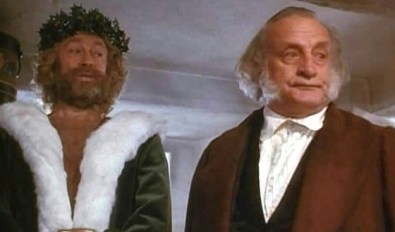 1) A Christmas Carol (1951) Nobody does it better than Alastair Sim. The film itself is a holiday masterpiece.
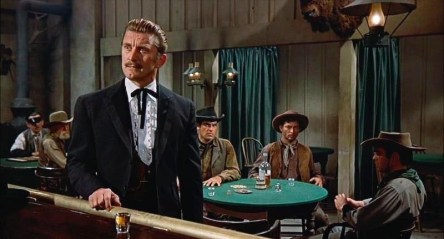 Today is Kirk Douglas’ 100th birthday. One of the last survivor’s of Hollywood’s classic era, Douglas gave us a series of roles ranging from the cynical (Ace in the Hole) to the heroic (Paths of Glory). Douglas, like his five time co-star, Burt Lancaster, were bigger than life on screen. They were stars, the type that no longer exist.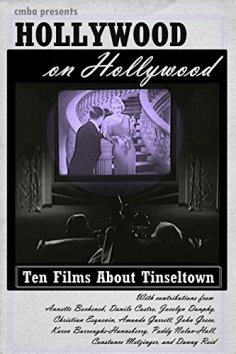
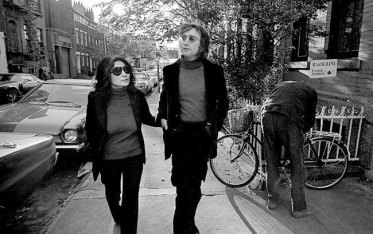 It happened on September 30, 1976. Martin Ritt’s film, The Front, starring Woody Allen, opened that day at the Coronet theater in New York. I have been, and still am, a huge Woody Allen fan since his standup days when I first saw him on the Ed Sullivan Show.
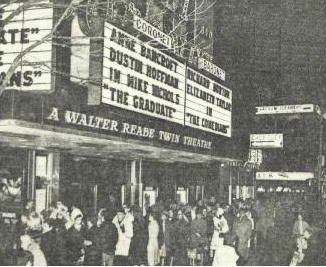 At the time, I was living and working in New York. Being the Woody fan that I was, I took a half day off from work to go see The Front. The Coronet theater was located on Manhattan’s Eastside. The Coronet, its sister theater, the Baronet along with the Cinema I and Cinema II were high end theaters. All the studios and distributors wanted their big films to be booked into these theaters. Foreign films like Bergman’s Cries and Whispers and Antonioni’s Blow-Up to domestic works like The Exorcist and The Graduate had their premiere engagements at one of these fours theaters located on the Upper East Side. The four theaters filled the entire block, between 59th and 60th streets, except for a Bookmasters store in between.
 The theater was fairly crowded for a weekday afternoon. In New York, Woody was always a big draw. After the film ended, everyone began filing out. It was at this time, I suddenly noticed walking out right in front of me among the crowd were John Lennon and Yoko Ono. Growing up in the 60’s, and a Beatles fan, I pretty much stood there stunned. In truth, while I saw the both of them, it was Yoko who I first recognized. I had to take a second look at who was standing next to her. Of course, it was Lennon.
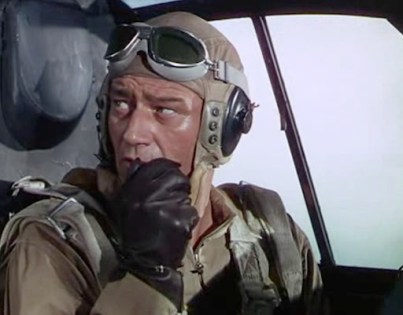 This weekend TCM pays tribute to America’s fallen heroes with three days of mostly pro-war films like The Flying Leathernecks (1951) and They Were Expendable (1945) both featuring the always hard-ass but plastic patriot John Wayne. When the war broke out stars like Henry Fonda, Robert Stack, Clark Gable and James Stewart joined the military. Wayne on the other hand did not. Though eligible, he felt his career was more important. Wayne managed to obtain a 3-A status, “deferred for family dependency.” He had four kids. Additionally, El Duko’s career was not on solid ground at the time. He had just completed Stagecoach and was on the road to stardom. Four or five years of military service could have ruined that. Additionally, actor’s in general, were given a bit of leniency because the Gov’t considered Hollywood a propaganda machine for the war effort.
  Robert Ryan is TCM’s Star of the Month. On Friday, May 6th beginning at 11am (ET) TCM will be showing 13 films of Ryan’s darkest works including The Racket, Act of Violence, On Dangerous Ground, The Set-Up and Beware, My Lovely.
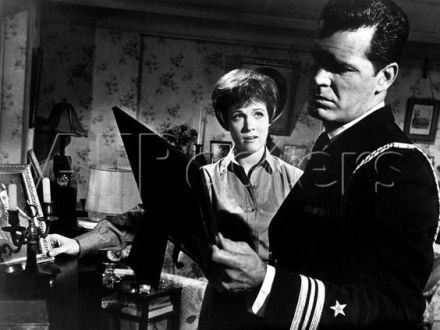 James Garner and Julie Andrews made a great team. Garner confesses in his blunt memoir (The Garner Files), the lovely Ms. Andrews was a great kisser and he really enjoyed doing their love scenes. They would reunite on-screen some eighteen years later in her husband’s (Blake Edwards) Victor, Victoria.
 Back in the 1970’s, after my discharge from the Army, I enrolled in a class at the New York Institute of Photography. I got interested in photography after I purchased my first 35mm camera while stationed in Vietnam and later learned some darkroom development techniques while stationed in Germany. I bring this up only because the instructor during one session asked the class who they thought was a better photographer, Richard Avedon or Gordon Parks. Why he selected these two I don’t remember. Anyway, I made it known that I thought Parks was the better photographer. The instructor who I later classified as a typical know it all who liked to belittle people told me how I was wrong and that Avedon was the better of the two. The class laughed as he seemed to go on about my choice and belittling me in the process. I shrunk into a quiet embarrassed mode. I hated the class for the rest of the few weeks that I silently attended before dropping out.
 Huddie Ledbetter, aka Leadbelly, aka Lead Belly was one of America’s great folk/blues singers. His influence on artists such as Woody Guthrie, Pete Seeger, Creedence Clearwater Revival, Bob Dylan, Johnny Rivers, Tom Waits, Ry Cooder, Elvis Presley and so many others has been well documented in their recordings. Huddie was inducted into the Rock and Rock Hall of Fame back in 1988.
 One of the finest parts of the film comes early on when Huddie meets Blind Lemon Jefferson. Lemon, another soon to be blues legend, is superbly played by Art Evans (Die Hard 2, A Soldier’s Story and many, many TV shows). The two bluesmen team up for a while performing on the road (in real life it was about two years). In one scene during this period they sing for white people at a dance party. It turns ugly when the evening begins to get late and Huddie decides to pack it in. However, one of the white folks wants him to continue and a fight ensues with Huddie getting badly beaten. It always seems even when Huddie wasn’t looking for trouble, it found him.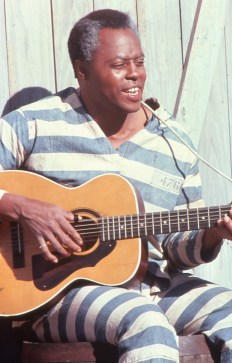
 The first time I watched Leadbelly was way back in ’76 at the time of its release. It was at the Loew’s State in Times Square. The showing I went to had a couple of live special guests, folksingers Sonny Terry and Brownie McGhee who met Leadbelly after he became a regular in the New York City folk scene. They reminiscence about their friend and sang some of his best known songs. It was a unique chance to see these two artists and learn a little more about their friend and a true legend.
 John Greco Author/Photographer