
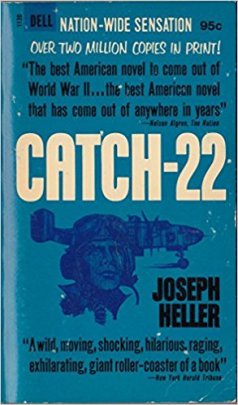
Ever asked what is your favorite book? Mine is Joseph Heller’s brilliant satire Catch-22. Published in 1961, Heller’s novel was prophetic portrayal of the rise of corporate power, greed, and war. At the time of its publication many were offended, some were confused. (1) This superb anti-war novel changed my life and the way I thought. I wrote about the book and film a while back on another blog and decided to post it here.
”You mean there’s a catch?”
“Sure there’s a catch,” Doc Daneeka replied. “Catch-22. Anyone who wants to get out of combat duty isn’t really crazy.”
“There was only one catch, and that was Catch-22, which specified that a concern for one’s own safety in the face of dangers that were real and immediate was the process of a rational mind. Orr was crazy and could be grounded. All he had to do was ask; and as soon as he did, he would no longer be crazy and would have to fly more missions. Orr would be crazy to fly more missions and sane if he didn’t, but if he was sane, he had to fly them. If he flew them he was crazy and didn’t have to; but if he didn’t want to, he was sane and had to. Yossarian was moved very deeply by the absolute simplicity of this clause of Catch-22 and let out a respectful whistle.”
“That’s some catch, that Catch-22,” he observed.
“It’s the best there is,” Doc Daneeka agreed. (Joseph Heller, Catch-22)

I first read Catch-22 when I was 19 years old. This was in the late ’60s just before being sent to Vietnam. It was the one book I took with me. Sometime during that deployment, I lost the book, but never its spirit.
Author Joseph Heller joined the U.S. Army Air Corp in 1942. He was 19 years old. In 1944 Heller found himself in Italy as a B-25 Bombardier. He flew 60 missions. For most of those flights, he encountered little or no enemy fighters or anti-aircraft artillery. He later categorized them as “milk runs.” His military experience and background would come to use later in his epic novel. His anti-hero Yossarian was a Bombardier just like him.
The illogical logic of Heller’s brilliant anti-war satire reveals the insanity of war. Yossarian (Alan Arkin) is an American Bombardier stationed in Italy. He’s convinced everyone wants him dead, not just the Germans, but his own officers. They keep sending him on dangerous missions! To stop flying these insane missions, his higher-ups inform him he needs to complete a certain number of missions. The only problem is when he or any other bombardier come near the magic number of missions required, his commanding officer raises the number of missions required to be rotated out. Yossarian insists the entire world is crazy including him. And if he is insane, he should not be flying these missions; however, the flight surgeon (Jack Gilford) declares that anyone who understands the insanity of the situation cannot be insane! Subsequently, Yossarian must continue to fly more missions. Like with many things in life, there is no escape.
Catch-22, the movie, and the book is a surrealistic trip that captures the absurdity of war, and a bureaucratic society in general, frame for frame, a mix of satire, comedy and tragedy. Though set during World War II the film, released in 1970, captured the spirit of the late 1960s: the Counterculture, the Vietnam War and the Rock Generation. Heller’s novel, published in 1962 was a progressive masterpiece that only gained in popularity, and cult status as the sixties moved on into the later years of the decade. When it was announced Mike Nichols would direct the film version, it was met with high expectations, so high that it almost guaranteed failure. Critics of the day were split. Roger Ebert called it “a disappointment.” He went on, “the movie is essentially a parasite, depending on the novel for its vitality…” On the other side of the coin, Vincent Canby writing in the New York Times said, Catch-22 “is quite simply, the best American film I’ve seen this year.” Either way, the film died at the box-office.
The film captures the anti-war message that was popular at the time and manages to convey the insanity of war, the hopelessness of the soldiers caught in the middle and the narrow-minded vision of the military mentality and its mindless gun-ho patriotic fever.
There was another anti-war film released that same year, Robert Altman’s M.A.S.H. a movie that was met with more of a universal reception and was a big hit. Though set during the Korean War, like Catch-22, it echoed Vietnam and its times.
Buck Henry who worked with Nichols on The Graduate was given the impossible task of adapting Heller’s novel to the screen, and many of the scenes are set-pieces. The cast of characters are colorful and portrayed for the most part with an absurdist bent. There’s Milo Minderbender (Jon Voight) who has set up his own business, selling valuable military gear. General Dreedle (Orson Welles) who spits out insane orders and expects them to be carried out exactly as ordered, Captain Nately (Art Garfunkel) who falls in love with a whore and Major Major (Bob Newhart) who will only meet with anyone when he is not there. Other cast members include Bob Balaban, Richard Benjamin, Paula Prentiss, Anthony Perkins, and Martin Sheen.
The film and the book are reminders that war is not glorious or heroic. Yes, men and women do incredibly heroic acts in dangerous situations and sacrifice a lot. Still, we should not glorify war. We should not make it attractive to our youth, to future generations. I know too many people who seem to relish war, in most cases as long as someone else is doing the fighting and sacrificing. They always managed not to go. But they are the first to raise the flag, hug it and yell sacrifice as long as it is not them.
(1) Read about genesis of Catch-22 here.
 Far ahead of its time, Elia Kazan’s A Face in the Crowd is a brilliant look at the media and its influence. Set your DVR for tomorrow at 1:45PM. Watch the film and then read about it in
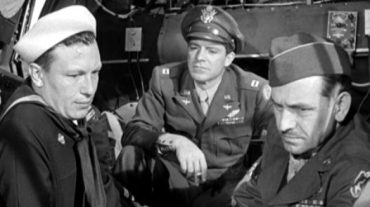 William Wyler’s superb film about returning veterans will be broadcast on TCM tonight at 10 PM eastern. The brilliant cast includes Dana Andrews, Fredric March, Myrna Loy, Theresa Wright, Virgina Mayo, and Harold Russell, A must see!
 Few novels have proven to be as important and influential as To Kill a Mockingbird, and few films have become just as important as its source material. Tom Santopietro (The Godfather Effect, Sinatra in Hollywood, Becoming Doris Day) is one of the finest pop culture writers working today. In his new book, the author take a deep dive look at the cultural impact of both Harper Lee’s Pulitzer Prize winning book, published in 1960, and the now iconic film released in 1962. Over its more than 50 years existence, To Kill a Mockingbird has been both praised and banned. Criticized and hailed by both liberals and conservatives.
 For years Rebecca Miller (Maggie’s Plan, The Ballad of Jack and Rose) had been researching, compiling, filming interviews and taking home movies of her father, Arthur Miller. From this wealth of material, Ms. Miller has produced a fascinating look at the life and career of one of America’s greatest playwright/writers.
 Though best known for plays like Death of a Salesman, All My Sons, The Crucible and A View from The Bridge, Miller never stopped writing throughout his life. He wrote 25 plays, numerous essays, short stories, novels and an autobiography (Timebends).
 Between 2005 and 2015, nine direct for TV movies were made based on Robert B. Parker’s Jessie Stone novels. Recently, I have been re-watching many of them, seven so far to be exact. Parker was one of my favorite authors. He passed away in 2010.
 Robert B. Parker was best known for his Spenser novels. Spenser, a Boston based, ex-boxer, poetry reading, gourmet cook, wise-ass talking, sensitive guy and tough in a fight as they come P.I. A fictional decedent of Raymond Chandler’s Philip Marlowe and Hammett’s Sam Spade. Predictably, a TV series, Spenser for Hire followed starring a very dull Robert Urich. However, the problem was not just Urich; it was the scripts. Though the show has its admirers, on TV, Spenser lost a lot. He became just another vanilla filled version of every other TV detective seen before and after. Four made for TV films followed starring Joe Mantegna as our hero. They were an improvement on the series, though no one was going believe Mantegna was an ex-boxer.
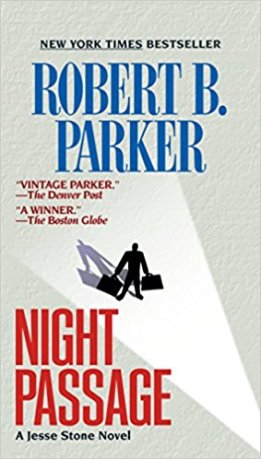 In 1997, Parker published his first Jesse Stone novel (Night Passage). Stone, an ex-L.A. detective, fired because of a drinking problem which began after his divorce from his wife, Jen. Jesse is hired as police chief of the fictional Massachusetts town of Paradise. The town council appointed him because they believed since he is damaged goods, they will be able to control him. Little did they know.
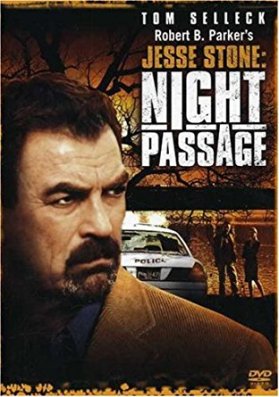 The first film (Night Passage) came out, as mentioned earlier, in 2005. Jesse is played by, with sharp assurance, by Tom Selleck. Jesse is damaged goods. He’s alcoholic, Johnny Walker Red his choice of drink. Moody, unwavering, iconoclastic and good at what he does. Throughout the books, and the films, Jesse is a man coming to terms with himself. Though his divorce haunts him, he does go out with other women but admits to all them he is not a good candidate for a permanent relationship.



 At 5’ 5” Joe Rosenthal had to place some rocks and sandbags on the ground for him to stand on so he could take what would become one of the most iconic photographs of World War II: the raising of the American flag on the small Japanese island of Iwo Jima. Located 760 miles south of Tokyo, the island was crucial to American forces strategies who planned to use the volcanic island as an air base in their march toward Japan.
 Joe Rosenthal

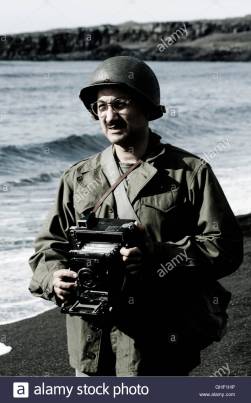

 Photography was in its infancy when Abraham Lincoln was running for President. It was a cumbersome and deliberate process. Cameras were these large boxes, set upon sturdy bulky tripods, using wet plates and a slow exposure making the possibilities of the sort of images captured limited.
  John Greco Author/Photographer